The Law of the excluded middle was a big mistake.
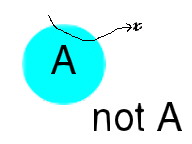
| First we make a distinction. We divide our universe of discourse into A and not A. Now in making this grand distinction we know, if we are wise, that we have not captured the entire universe in our simple distinction; but for for the sake of argument we proceed. Let us say we wish to investigate that part of our universe that is not A. Graphically we are at the x in the figure below. |
| As we travel with x in our investigations of our new universe we encounter another distinction and wish to name it B. We make this new distinction from its background that we have been calling (not A). Graphically we are at the x in the figure below. |
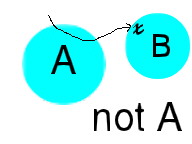
| Now we have a choice. Is x in A or not? Was this second distinction that we have encountered while traveling in the background of (not A) the same distinction we named A, or is this a totally new distinction that was unknown to us when originally narrowed the universe of discourse to A or not A ? So graphically we are either at x or at y in the figure below. |

| Several millennia ago some man
made up a law. Today that law is one of the laws of thought of
our culture. That law states that not (not A) is A and
that we have no choice in the matter. But as you can easily see
in the diagrams above, there certainly is a choice.
Who was that man? I wish to hold him personally responsible for this mistake. |
Please see 'Why the Disjunction in Quantum Logic is Not Classical' for another example.
¤~~~~~~~~~¤~~~~~~~~~¤~~~~~~~~~¤~~~~~~~~~¤~~~~~~~~~¤

| Perhaps a more scientific pair of definitions would be
| that anything is 'general' in so far as the principle of
| the excluded middle does not apply to it and is 'vague'
| in so far as the principle of contradiction does not
| apply to it.
|
| Thus, although it is true that "Any proposition
| you please, 'once you have determined its identity',
| is either true or false";  yet 'so long as it remains
| indeterminate and so without identity', it need neither
| be true that any proposition you please is true, nor that
| any proposition you please is false.
|
| So likewise, while it is false that "A proposition 'whose
| identity I have determined' is both true and false", yet
| until it is determinate, it may be true that a proposition
| is true and that a proposition is false.
|
| Charles Sanders Peirce, 'Collected Papers', CP 5.448

¤~~~~~~~~~¤~~~~~~~~~¤~~~~~~~~~¤~~~~~~~~~¤~~~~~~~~~¤

Check out:
Mind from Brain - A Consequence of our species' adaptations to paradox processing?
by Chris Lofting
Especially the pictures
	http://pages.prodigy.net/lofting/Slide11j.jpg
	http://pages.prodigy.net/lofting/Slide13j.jpg
	http://pages.prodigy.net/lofting/opti4.jpg


And finally a possible way to avoid the excluded middle:
Last Revised 4/30/2003
(c) 2000, 2001, 2002, 2003 Seth Russell
[email protected]
